Every appointment starts with a search.
Someone is going to look you up before they put your name forward. We rebuild your website so that search goes well, then keep documenting your projects so it stays that way.
Five people, running five different checks.
Nobody will tell you they've been on your site. They search, they click through, they form a view, and either your name goes forward or it quietly doesn't. Here's what each of them is actually looking for.
Building a shortlist for a live programme. Three or four names, and every one has to stand up when the client asks why they're on the list.
- Is this site credible enough to forward to the client?
- Have they delivered this building type at this scale?
- Who's on the team, and are those people still there?
What fixes it. Case studies that name the building, the scale and the programme constraint, so a PM can match you to their scheme without picking up the phone.
About to put your name in front of a hotel group or a developer. If you underperform, it reflects on them, so they check properly.
- Can I send this to a client without apologising for it?
- Is that real photography, or stock and phone shots?
- Do they operate at the level our client expects?
What fixes it. Professional photography of finished work, on named schemes. It turns your page into something a contractor forwards willingly.
Your name came up in a meeting and they're doing their own quiet check before the introduction goes any further.
- Does the work match how it was described to me?
- Do I recognise any of these buildings?
- Is this an established firm or one person with a logo?
What fixes it. Recognisable buildings, photographed properly, published regularly enough that the quality reads as consistent rather than a one-off.
Specifying a consultant or a specialist trade for a heritage, listed or technically awkward scheme. They want precedent before they commit your name to a drawing.
- Have they done this exact thing before?
- Any conservation or listed building experience?
- Will they hold a specification under scrutiny?
What fixes it. Writing up the technical constraint on each job and how it was met. That's the detail that turns a general enquiry into a specification.
Working out whether a firm is the right commercial fit before recommending an appointment to the client team.
- What scale of work have they genuinely handled?
- Are they established enough to carry the risk?
- Is there evidence of delivering to programme?
What fixes it. Value bands, programme durations and phased delivery stated plainly. These are the commercial signals a QS is scanning for.
Most sites in this sector were built once and never touched again.
Usually around 2019, by someone's nephew or a template outfit, and it shows. Drag the handle below. The site on the right is a real client of ours, and the one on the left is what we typically find when we start.
We are a family run business with over 25 years experience in the industry. We pride ourselves on quality workmanship and customer satisfaction, offering a professional and reliable service at competitive rates throughout London and the surrounding areas.
- Commercial & Residential
- Interior & Exterior
- Free Estimates
- Fully Insured
For a free no obligation quotation please do not hesitate to get in touch with a member of our friendly team.
What that costs you
The site says what you do without ever proving you've done it. Half your visitors open it on a phone, where it loads slowly and reads badly. There's a gallery with four photographs in it, none of them recent. Nothing on the page gives a project manager a reason to forward it, so they don't, and you never find out that you were considered.
What we do instead
We structure the site around your projects rather than your services, because that's the order buyers look in. It loads fast on a phone, it's indexed for your discipline and sector, and it's built to keep absorbing new case studies rather than freezing on launch day. Every page ends somewhere sensible.
Six sections, every time
Not a template. These are just the six things every buyer above goes looking for, roughly in this order.
The centre of the site rather than an afterthought, filterable by sector and building type. Each one is a full case study with photography, scope and outcome, not a thumbnail and a caption.
Answers"Have they delivered this building type, at this scale?" This is the first thing a PM or contractor checks and usually the last one they need.
Named people, real photographs, actual tenure. Who runs the projects and who a client would be dealing with.
Answers"Is this a real firm?" It also wins you staff, which matters more than most firms expect.
What you do and what you don't, written plainly. Scope boundaries, typical value bands, what you self-deliver.
AnswersStops you being ruled out for packages you could comfortably have delivered.
CHAS, SafeContractor, ISO, trade body membership, insurance levels. Presented properly rather than buried in a footer.
AnswersThe PQQ questions, before anyone has to ask them.
The contractors and consultancies you've worked for, with testimonials attributed to named roles rather than initials.
Answers"Do they operate at our client's level?" Recognition does the work here.
One obvious next step on every page, going to a person rather than an inbox nobody checks.
AnswersRemoves the last bit of friction between interest and an enquiry.
A website is only up to date on the day it launches.
Which is why the second half of this matters more than the first. Every month we document one completed project properly, so the body of evidence keeps growing while you get on with the actual work.
One completed project a month, shot to architectural standard by a London-based photographer we brief and book. Not a site phone snap, and not something you have to organise.
A short interview with whoever ran the job, then a case study covering the brief, the scope, the thing that made it difficult and how it landed. Written for a PM reading a shortlist, so no adjectives doing the work of evidence.
Live on your own site, then out on LinkedIn as a long-form article and a short post. Your entire commissioning chain is on that platform daily, and almost none of your competitors post anything worth stopping for.
Where each one actually gets used
The website is where it lives. The value is in everywhere else it ends up.
Relevant experience is a scored section on almost every submission you complete, and it's usually written at nine o'clock the night before by whoever drew the short straw.
Each case study is built with exactly the detail those questions ask for: the building, the scope, the value band, the programme, the constraint and the outcome. Your bid team lifts it straight in. Over a year that's twelve pre-written, properly photographed submissions sitting ready, which is a saving your directors will feel long before the marketing benefit shows up.
A documented body of work is what turns a capability statement from a list of claims into something a client-side team can verify. Useful for framework applications and supply chain onboarding.
Our team also writes the pieces that position you as someone worth asking: working in listed buildings, delivering inside live hotels, handling phased handover. Written by people who've sat client-side, so it reads as experience rather than marketing.
One case study opens a door. A year of them changes the conversation.
The individual write-up isn't really the point. The point is what twelve of them look like sitting together.
We agree which completed scheme to document, chosen for the work you want more of rather than whatever finished most recently.
Photographer on site, access coordinated around your team and the client's. You arrange nothing.
A short interview with your project lead, then a draft with you for review. Nothing goes live without your sign-off.
Live on your site and out on LinkedIn, timed to land with the people commissioning work like yours.
Rebuilt, quick, and launched with your strongest projects already documented. Something you're glad to send rather than quietly reluctant to.
Six schemes documented across the building types you want more of. A contractor has something to forward, and a PM has something to verify.
A year of documented delivery, searchable and in circulation. People know who you are before they need to ask around.
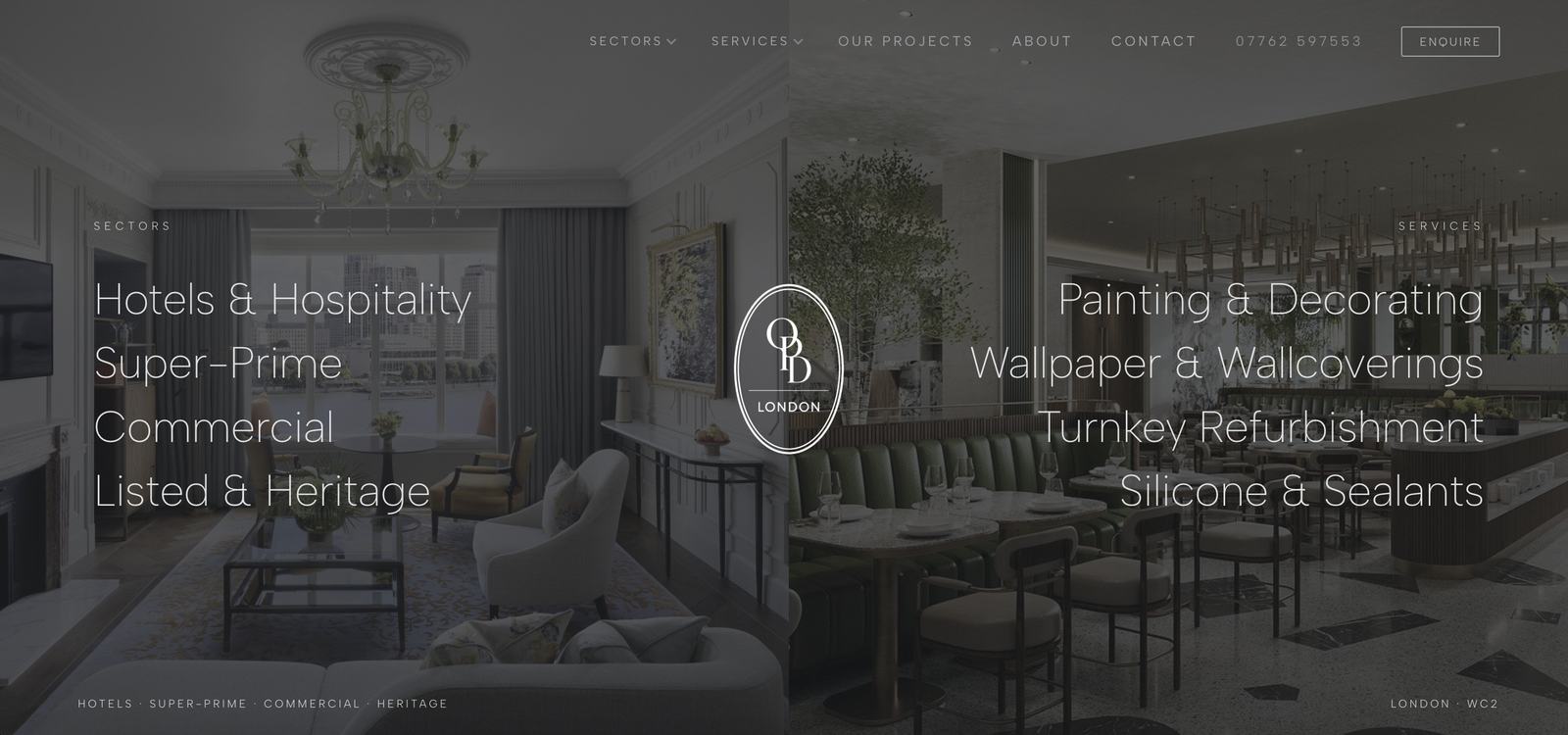
QPD London
A specialist decorating contractor working across five-star hotels, super-prime residential and heritage interiors. Everything below is the format we'd apply to your projects.
at The Savoy
commercial, heritage
documented portfolio
five-star hotel
QPD had decorated guest rooms at The Savoy and the public spaces at Hilton Park Lane, along with a run of super-prime residential across W1, SW3 and SW7. None of it existed anywhere a prospective client could see. The credentials were real and completely invisible.
"Delivered on programme, in a live hotel, to the highest standards."
Contracts Manager, London fit-out programme. The documented portfolio went into a later hotel decoration tender, which QPD won.
Worth noticing what the format is doing. It names the building so a buyer can place it. It states the constraint, because that's the part a PM is actually assessing: anyone can paint a room, but delivering inside a live five-star hotel to programme is the credential. And it finishes on something verifiable instead of an adjective.
Rebuild once, then keep it fed.
A website designed and written to win appointments, launched with your strongest projects already documented.
One completed project documented every month, working for you from the day it goes live.
Tell us what you want to be known for.
Your discipline and the kind of commission you'd like more of. I'll come back within a working day, and there's no pitch deck at the end of it.